
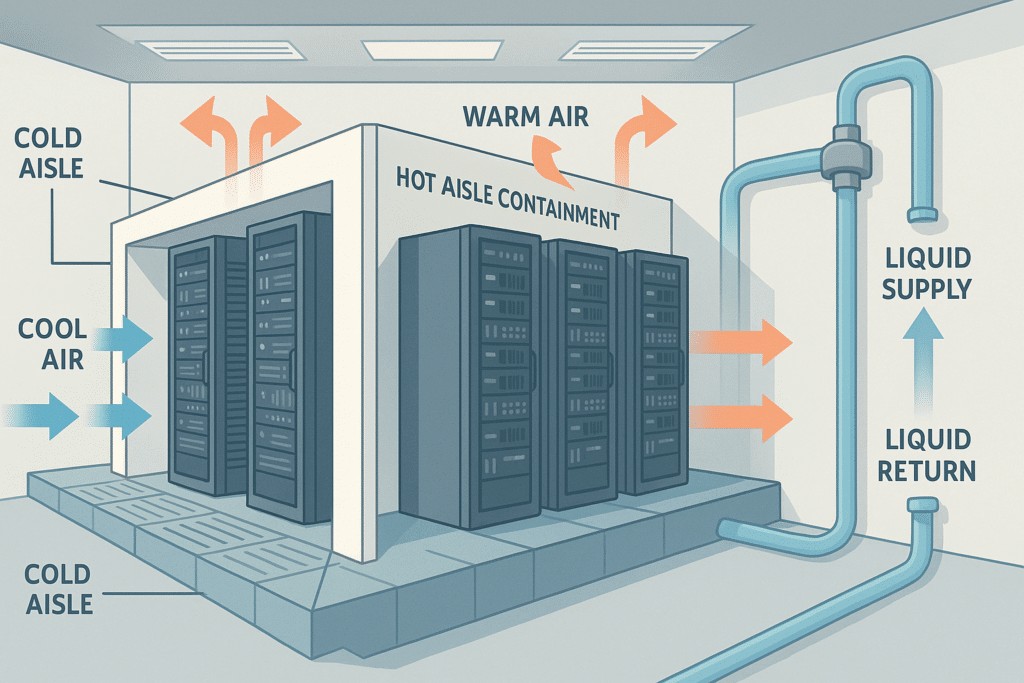
For decades, air cooling kept data centers running. Cold air went in the front of the rack, hot air came out the back, and large cooling units moved the heat away. That approach worked well for traditional servers, but modern AI hardware is changing the equation. The heat produced by dense GPU clusters is pushing many facilities toward liquid cooling.
Nowhere is that shift more visible than in the AI factory, where large GPU clusters run at power levels far beyond conventional server rooms. Here is why liquid cooling is becoming central to AI infrastructure, and what the main options look like.
The Heat Problem
Every watt of electricity that goes into a server comes out as heat. Traditional racks might draw a modest amount of power, which air can handle. AI racks are a different story. As chips get more powerful, their thermal design power rises, and a single rack can draw many times what a conventional rack does.
At those densities, air runs out of room. Moving enough air to cool a very dense rack would require extreme airflow, large fans, and a lot of energy, and even then it may not be enough.
Why Liquid Works Better
Liquids carry heat far more effectively than air. Water, for example, can absorb and move much more heat per unit of volume than air can. That makes it a natural choice when the amount of heat per rack goes up.
Many practitioners point to a rough threshold: once rack power climbs past a few tens of kilowatts, direct-to-chip liquid cooling starts to become necessary. Beyond that point, air alone struggles to keep chips within safe temperatures.
Main Types of Liquid Cooling
- Direct-to-chip cooling: Cold plates sit directly on the hottest components, such as GPUs, and liquid flows through them to carry heat away. Air still handles lower-power parts.
- Immersion cooling: Servers are submerged in a special non-conductive fluid that absorbs heat directly.
- Rear-door heat exchangers: A liquid-cooled door at the back of the rack removes heat from exhaust air before it enters the room.
- Hybrid designs: A mix of liquid and air cooling that matches the cooling method to each part of the system.
Each approach has trade-offs in cost, complexity, and compatibility, and many facilities use more than one.
Fewer Fans, More Facility Infrastructure
Some current-generation AI servers are designed with few or no internal fans. That does not mean less cooling is needed. Instead, the cooling burden shifts from the server itself to the facility, which has to deliver liquid to each rack reliably and at the right temperature.
That change makes the design of piping, pumps, heat exchangers, and monitoring systems a first-order concern, not a detail.
Benefits Beyond Raw Cooling
Liquid cooling is not only about handling heat.
- Higher density: More computing power fits in the same space.
- Better efficiency: Less energy goes into moving air, which can improve overall efficiency.
- Quieter operation: Fewer large fans means lower noise in the white space.
- Heat reuse potential: Warmer liquid can sometimes be reused for nearby heating needs.
Challenges to Plan For
Liquid cooling also brings new considerations.
- Leak prevention and detection: Systems need careful design, quality fittings, and sensors.
- Retrofitting: Adding liquid cooling to an existing air-cooled facility can be complex.
- Skills and procedures: Operations teams need training for new maintenance routines.
- Compatibility: Servers, racks, and cooling hardware have to work together.
- Monitoring: Real-time data on flow, temperature, and pressure is essential.
Designing for the Whole System
Cooling does not stand alone. It connects to power, space, and software. A well-planned design considers how liquid loops, power distribution, rack layout, and monitoring tools fit together. Simulation and digital modeling can help teams test those relationships before anything is built.
For general guidance on thermal design in data environments, the ASHRAE thermal guidelines are widely used across the industry.
Planning Questions to Ask Early
- What rack densities do we expect now, and in a few years?
- Which parts of the facility will use air, and which will use liquid?
- Can the building support the weight, piping, and heat rejection equipment?
- How will we monitor and maintain the cooling system?
- What is our plan for expansion?
The Shift Is Already Underway
Liquid cooling has moved from a niche option to a mainstream design choice for AI. As chips continue to draw more power, facilities that plan for liquid early will be better positioned to scale, while those that rely only on air may find their options limited. For anyone designing or upgrading AI infrastructure, understanding liquid cooling is no longer optional.